Zentropi Now Powers Coop
Zentropi labelers can now be used as classifiers within Coop, ROOST's Open Source Moderation Platform
We built Zentropi so that teams could create accurate content classifiers in minutes, not months. Today, we're excited to share that Zentropi labelers are now integrated as a signal source in Coop, the open source content moderation platform from ROOST.
This matters because it demonstrates something we've believed from the start: policy-steerable classifiers should work everywhere. Your moderation stack, your review tool, your agentic pipeline—wherever you need a classification decision, Zentropi should plug in.
What is Coop?
Coop is ROOST's open source review tool for content moderation. It provides the full operational layer that sits between your platform and your reviewers: queues, routing rules, a review console, automated enforcement, analytics, and specialized child safety workflows. Best of all, it runs on your own infrastructure.
Coop has a concept called signals—scores from external classifiers that feed into routing decisions and reviewer interfaces. When content arrives, Coop's rules engine evaluates signals against configurable thresholds to determine whether to auto-action, route to a queue, or escalate for human review.
That's where Zentropi comes in.
How the Integration Works
Zentropi labelers produce two outputs: a binary label (0 or 1) indicating whether content violates a given policy, and a confidence score (0 to 1) reflecting how certain the model is.
Coop expects a single score on a 0-to-1 scale, where higher means more likely violating. We map between the two with a simple formula:
score = label === 1 ? confidence : (1 - confidence)
A few examples of what this looks like in practice:
This preserves the full information from the Zentropi classifier in a single dimension that works naturally with Coop's threshold-based rules. You can write rules like GREATER_THAN 0.7 to catch high-confidence violations, or route uncertain cases (scores near 0.5) to human reviewers.
Why This Matters
There's a broader point here. The trust and safety ecosystem has historically been fragmented—every platform builds its own stack from scratch, and the tools don't talk to each other. ROOST is changing that with open source infrastructure. Zentropi is changing it by making classifiers that adapt to any policy without retraining.
When you combine the two, you get something powerful: an open moderation stack where the classification layer understands your specific policies, not just generic harm categories. You can write a policy in plain English on Zentropi, deploy it as a signal in Coop, and have content flowing through a review pipeline within minutes.
This is also a proof point for Zentropi's architecture. CoPE, the open model that powers our platform, was designed from the ground up to be policy-steerable—you give it a policy, it classifies content against that policy (see model card for details). No retraining, no fine-tuning, no waiting. That design makes Zentropi a natural fit as a signal source in any moderation system, not just Coop.
Getting Started
Setting up Zentropi in Coop takes just a few steps:
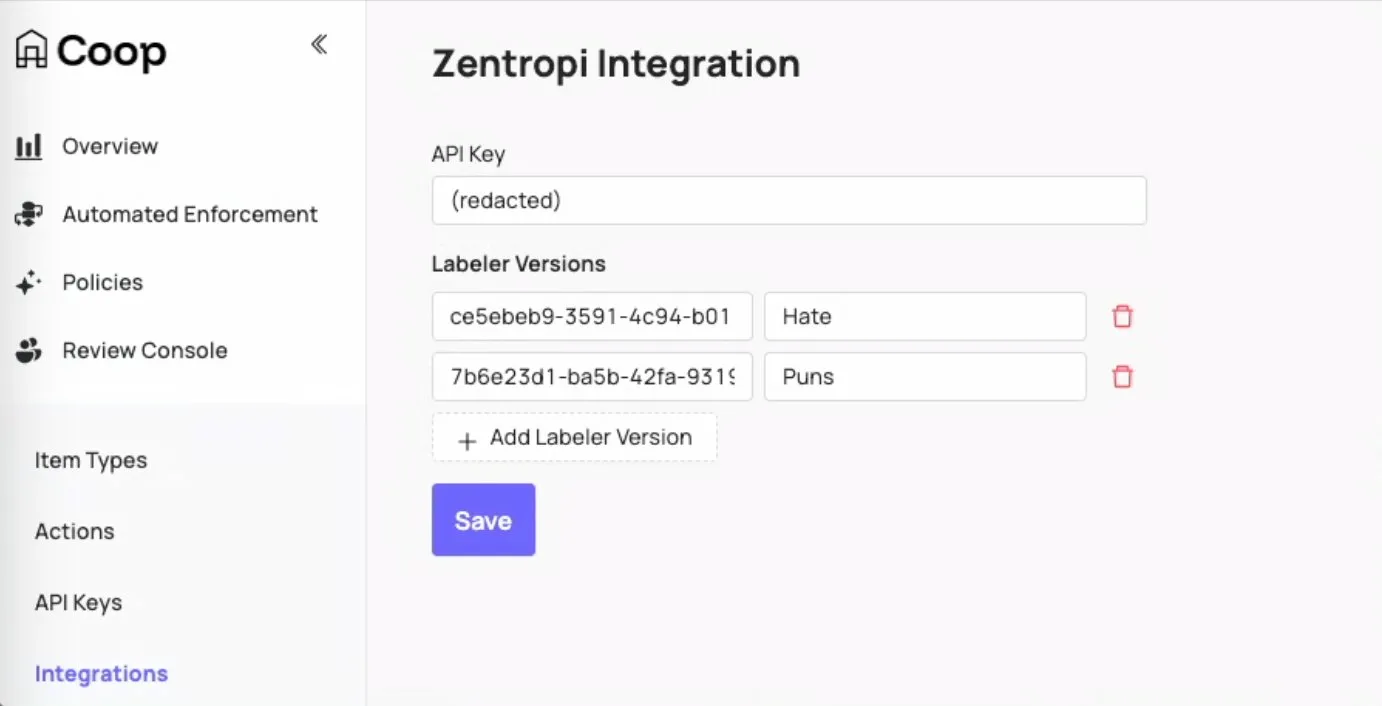
Step 0: Activate the integration. In Coop's Integrations settings, enter your Zentropi API key and add the labeler version IDs you want to use. Each labeler version gets a name (like "Hate" or "Puns") so it's easy to reference in rules.
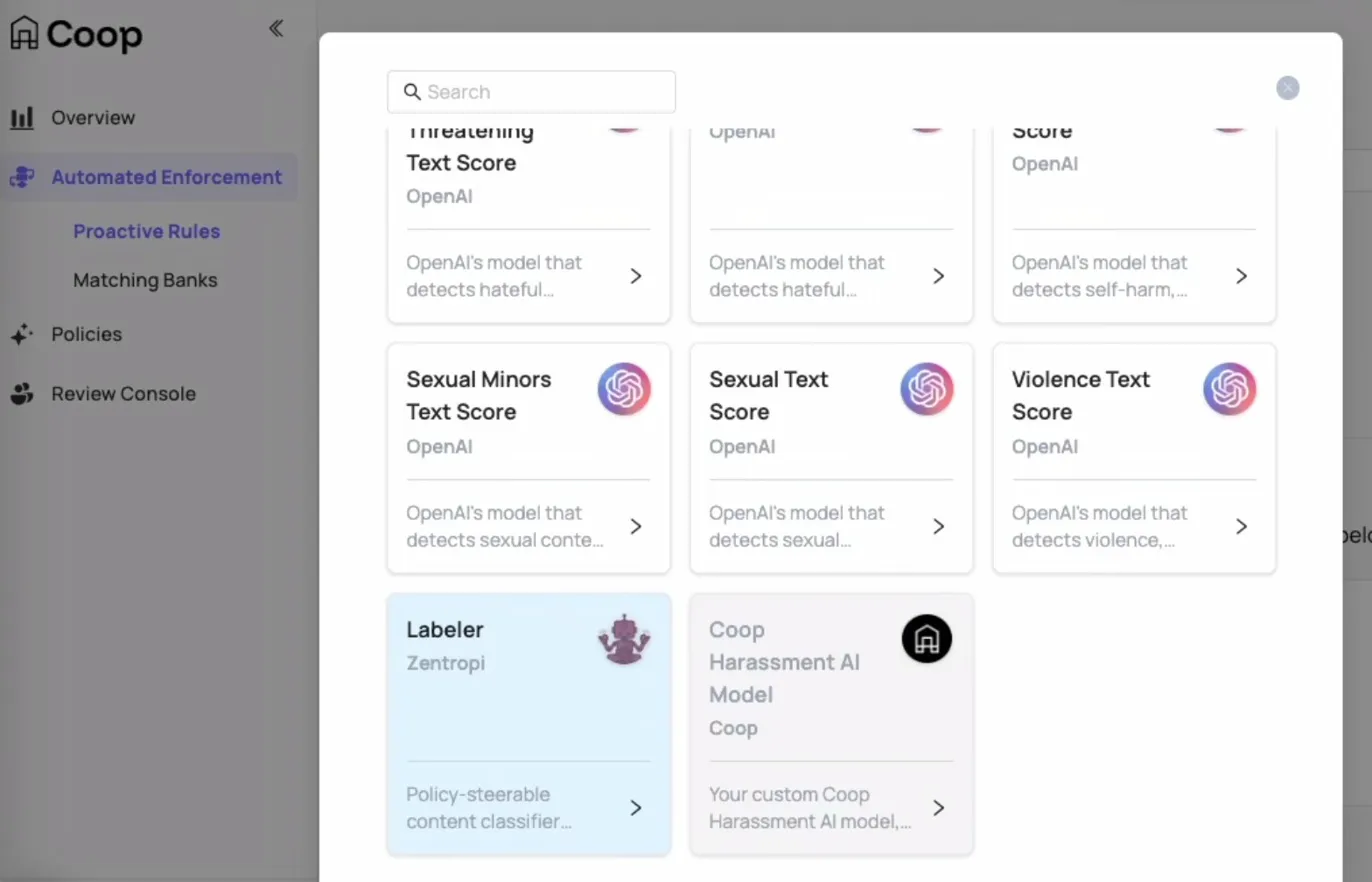
Step 1: Pick the Zentropi signal. When creating an enforcement rule, you'll see Zentropi Labeler appear alongside other signal sources like OpenAI's moderation scores. Select it as the signal for your rule.
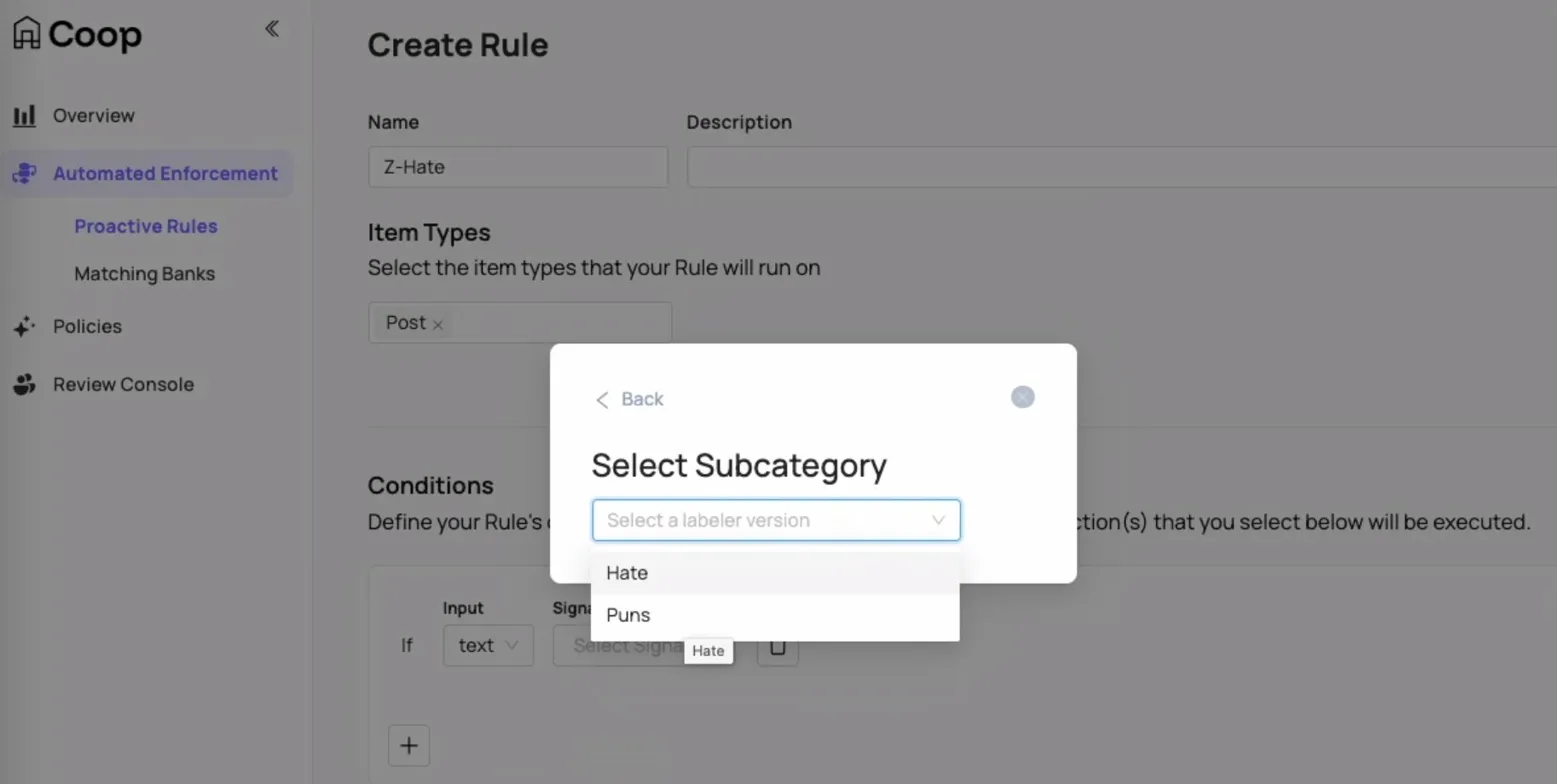
Step 2: Select your labeler. Choose which specific labeler version to use as the subcategory for the rule. This is where the policy-steerable part comes in—each labeler enforces a different policy, so you can have separate rules for different harm categories, all powered by Zentropi.
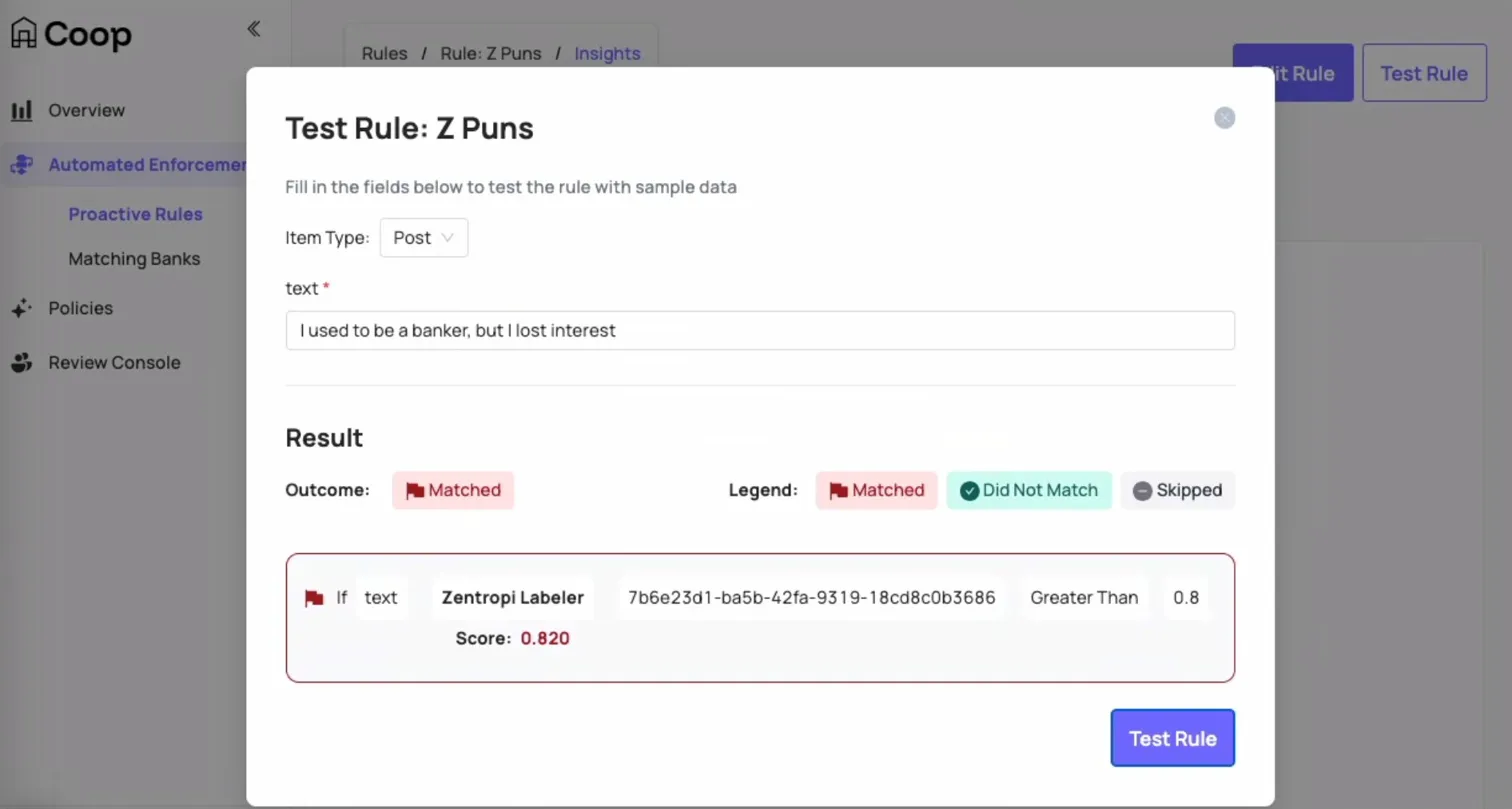
Step 3: Set thresholds and test. Configure your threshold (e.g., "Greater Than 0.8") and test the rule right in the UI with sample content. You'll see the Zentropi score in real time and whether it triggers the rule.
If you're not using either tool yet, now's a good time to try both! Zentropi's Community Edition is free and gives you unlimited labelers. Coop is fully open source and runs on your infrastructure.
We think the future of trust and safety is modular, open, and policy-driven. This integration is a step in that direction, and we're looking forward to seeing what teams build with it.
Create your first labeler at zentropi.ai. Check out the Coop project on GitHub. Questions? Reach out at info@zentropi.ai.