Meet CoPE-B-S1: A Decision Model Tuned for Safety

Today we're launching CoPE-B-S1, a safety-tuned decision model that speaks the System One spec, answers many policy questions in a single pass, and can be self-hosted.
TL;DR
- CoPE-B-S1 is a new member of the CoPE family: a decision model you hand your own criteria to, in plain language, and get back calibrated, structured decisions.
- It does multiple labels in a single pass — ask it many policy questions at once and the cost stays roughly constant (controlling for prompt length).
- It's open-weight and self-hostable while also being natively cross-compatible with Jev (same System One JSON format).
- It's tuned for safety but general-purpose — it's a good enough general decision-maker that it can even beat Jev in a game of Tetris.
- It's the most policy-steerable model of its size, and it keeps the speed and accuracy that CoPE is already trusted for in production by some of the largest websites in the world.
- Download it from Huggingface, run it on your own infra in our custom SGLang container, or access it via the Zentropi API.
Decisions, Decisions!
When we released the original CoPE model almost two years ago, we made a bet that small models for fast and accurate classification would become essential AI infrastructure. Now decision models have finally made that idea mainstream.
Jev deserves credit for popularizing this pattern through its elegant System One developer API. But as we tried putting decision models to work on real safety problems, we kept hitting three walls that today's System One models — and the many LLM-based clones chasing them — don't get past:
A. True Policy Steerability: Safety systems must be governed by nuanced policies, but most off-the-shelf models discern subtlety quite poorly as evidenced by our policy steerability benchmark.
B. Fast Multi-Label Inference: Nearly all the Jev copycats out there still require calling the model K times for K different labels/decisions, making multi-policy evaluation inefficient.
C. Self-Hostable and Open Weight: The best of today's crop of decision models are API-only, forcing platforms to reckon with privacy, security, and customizability challenges.
We believe the safety community needs a decision model that's designed for its unique requirements. So today we are releasing CoPE-B-S1 as an open weight model that can overcome these limitations. It is the latest chapter in years of our research at Zentropi. The model is highly accurate at following criteria, efficient on detailed policies, and can output multiple labels in a single call.
Tuned for Trust & Safety
Since the start, all of our CoPE models have optimized for content policy interpretation accuracy. We pioneered the contradictory policy method (as detailed in this research paper) which is what makes our models especially good at interpreting whatever criteria you hand them. We even developed a benchmark called policy steerability that quantifies the ability for models to follow your rules.
For this release of CoPE, we've augmented the number of safety domains the model is trained on, which makes it not only the most policy-steerable CoPE model we've ever made, but also the most steerable model of its size. For reference, our prior text model CoPE-B-A4B scored 0.634 and CoPE-B-S1 now scores 0.766.
This means that whenever you need a decision model to faithfully interpret very complex criteria (e.g., on the order of many paragraphs or pages), CoPE-B-S1 truly shines. This is particularly important for high stakes decisions like deactivating user accounts, triggering an LLM refusal, or supervising a risky agent tool call.
Multi-Label in One Pass
In safety you rarely ask one question. A single piece of content gets checked against many policies at once — hate? harassment? a credible threat? self-harm? CoPE-B-S1 answers all of them from one forward pass, so adding more policies barely moves your latency (when controlling for prompt length). In fact it generates zero output tokens — every answer is read directly from the prefill.
While multi-label inference has been our community's number one request for us, it has been a genuinely hard problem for LLMs to solve. Most decision models handle it in one of two unsatisfying ways:
- Sacrifice independence. Ask a decoder-based model several questions in one prompt and its answers contaminate each other — the verdict on one policy sways the verdict on another. Bundling decisions is cheaper but less accurate.
- Punt to multiple passes by doing one call per policy. That restores independence, but the cost and latency then scale linearly with the number of policies. When you're screening everything against a large policy set in real time, this is brutal.
There's a second, quieter inefficiency too. Most decision models assume the state (content) is the big part and the questions (policies) are the small part. For serious safety work that's backwards — good policies are detailed, and you reuse them across millions of items. A model that re-reads your entire rulebook from scratch on every call is paying, over and over, to re-process the part that never changes.
We've been working on cracking this problem for more than a year. We've now figured out how to better train for label independence directly to retain a high level of accuracy even when asked together. And we also built a special serving stack around policy reuse so a large, fixed policy prefix is processed once and reused across the content stream.
For trust & safety teams, this means you can now screen one piece of content against a policy set at very high throughput. And for cases where you need to ensure the highest level of accuracy, you can still re-run low confidence decisions on their own before taking a sensitive action.
Self-Hostable Open Weights
Safety teams often deal with extremely sensitive data that also has rigorous compliance requirements. Shipping all your data to an API in the cloud isn't always the right choice for production traffic due to these security and privacy considerations. That is why all of our models are self-hostable. Self-hosting isn't just a convenience or a cost play– it also enables teams to tailor a deployment for their needs.
For example, every single platform has a different distribution of data, so there is no such thing as a universal calibration for classifiers. CoPE-B-S1 both comes with improved calibration out of the box as well as the ability to set your own per-type temperature to maximize calibrated confidence. Drawing a line between taking down a post and escalating it for review can now be done precisely.
We know safety teams often reckon with impossible tradeoffs, so having control over accuracy, latency, cost, and confidence levers via self-hosting is critical to protecting healthy platforms. As with our prior model, CoPE-B-S1 is available under an Apache 2.0 license and is part of the Roost Model Community to support a thriving ecosystem of open safety tooling.
Not Just For Safety
While we built CoPE-B-S1 to tackle content safety, since it speaks the System One spec, it can actually serve as a highly capable general decision model. It's happy to make any typed decision you can describe — classification, entailment, routing, extraction-as-choice, etc.
CoPE-B-S1 implements the System One spec exactly — typed noul / choice / score questions over a state, with answers calculated in the same JSON shape. If you're already building against Jev or any decision model, swap in CoPE-B-S1 just by changing endpoints. No new SDK or migration needed. It just works.
How general can CoPE be? For fun, we had it play Tetris by reframing the game as a series of choice classification questions per piece. Much to our delight, it keeps the stack low and flat. In a head-to-head, it holds its own against Jev and can even beat it decisively.
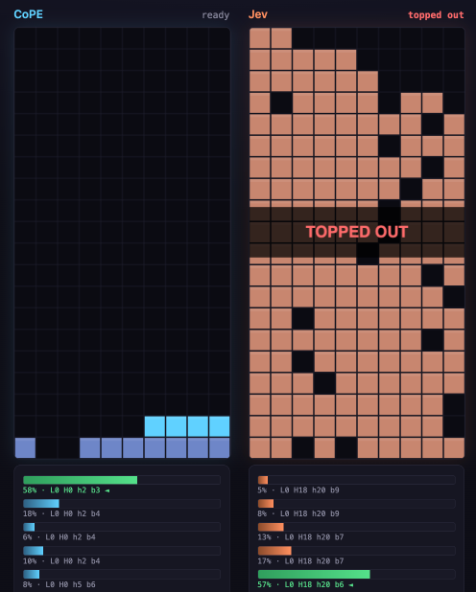
This is a playful example, but the point is serious: the same engine that screens your content against your policies is a dependable general-purpose decision-maker. We believe there may be more classes of problems for which having strong safety discernment might actually lead to higher performance. We're excited to explore this frontier in our future research.
Battle Tested
In the last few weeks, numerous vibe-coded decision models have appeared on the scene, wrapping generic LLMs in a Decisions API. CoPE-B-S1 is not one of them. It is instead the product of years of research into making the best possible steerable classifiers.
The CoPE family of models already serve as the real-time safety layer at platforms like Runway ML (where they guardrail video generation) and by some of the largest sites on the internet. CoPE-B-S1 inherits that proven speed and accuracy — now in an open, multi-label, System One-native package.
Getting Started
- Download the open weights: zentropi-ai/cope-b-s1 on Hugging Face.
- Self-deploy in one line: use this pre-built SGLang container to get a local
/v1/systemoneendpoint:docker run --gpus all -p 80:80 -e MODEL=zentropi-ai/cope-b-s1 zentropiai/cope-s1-sglang - Also available via the Zentropi API (free tier available) if you'd rather use a simple content labeling API. Just set
model=cope-b-s1.
We've spent years obsessing over how to make the most powerful, usable, and steerable content decision models in the world — and now the newest one is open, System One-native, multi-label and yours to run. As AI-powered systems become increasingly capable and the need to guide them grows, we hope that CoPE-B-S1 gives teams a new and important tool for their toolchest.